Εμφάνιση αναρτήσεων με ετικέτα Πρόκλος. Εμφάνιση όλων των αναρτήσεων

24 Φεβρουαρίου 2019

319. Georgia on My Mind: Petritsi and the Proclus Revival

319. Georgia on My Mind: Petritsi and the Proclus Revival

The Neoplatonist Proclus gets mixed reviews from Christians, as Nicholas of Methone refutes him but the Georgian philosopher Ioane Petritsi helps to revive his thought.

Further Reading

• L. Alexidze (trans.), Ioane Petrizi: Kommentar zur Elementatio theologica des Proklos (Amsterdam: 2009).

• P. Adamson and F. Karfik, “Proclus’ Legacy,” in All From One: a Guide to Proclus, ed. P. d’Hoine and M. Martijn (Oxford: 2016), 290-321.
• L. Alexidze, “The Supreme One: Its Transcendence and its ‘Kataphatic’ Characteristics in Ioane Petritsi’s Philosophy,” Bochumer philosophisches Jahrbuch für Antike und Mittelalter 20 (2017), 63-86.
• S. Gersh (ed.), Interpreting Proclus: from Antiquity to the Renaissance (Cambridge: 2014).
• L. Gigineishvili, The Platonic Theology of Ioane Petrisi (Piscataway: 2007).
• S. Mariev (ed.), Byzantine Perspectives on Neoplatonism (Berlin: 2017).
• G. Podskalsky, “Nicholas von Methone und die Proklos-Renaissance in Byzanz,” Orientalia Christiana Periodica 42 (1976), 509-23.
• J.M. Robinson, “Dionysius against Proclus: the Apophatic Critique of Nicholas of Methone’s Refutation of the Elements of Theology,” in D.D. Butorac and D.A. Layne (eds), Proclus and his Legacy (Berlin: 2017), 249-69.
Stanford Encyclopedia: Joane Petrizi

13 Φεβρουαρίου 2019

Review: Lamberton on Baltzly, Finamore, and Miles, Proclus: Commentary on Plato’s ‘Republic’. Volume I

Image result for Baltzly, Finamore, and Miles, Proclus: Commentary on Plato’s ‘Republic’. Volume I
Robert Lamberton (of Homer the Theologian fame) has published a very review of the new Cambridge UP translation of the first half of Proclus's Commentary on the Republic. Great review of great scholarship of a great work by a great ancient thinker. Read it at BMCR here. The specs for the volume are as follows:

Dirk Baltzly, John F. Finamore, Graeme Miles, Proclus: Commentary on Plato's 'Republic'. Volume I: Essays 1-6. Cambridge; New York: Cambridge University Press, 2018. Pp. xii, 431. ISBN 9781107154698. £79.99.
The book's official page at CUP, with TOC, can be found here.

4 Μαρτίου 2018

New book: Timotin, La prière dans la tradition platonicienne, de Platon à Proclus


Andrei Timotin's latest has just been published - a comprehensive treatment of prayer in the Platonic Tradition. His book on demonology in Platonism is the definitive treatment on the subject, and really a must-read for anyone interested in demons and divine intermediaries in late ancient Mediterranean literature, so this one promises to be worthwhile as well.
From the Brepols website:
Andrei Timotin, La prière dans la tradition platonicienne, de Platon à Proclus
Languages: French

Le présent ouvrage étudie la prière comme catégorie de la pensée religieuse platonicienne, de Platon à la fin de l’Antiquité.

The present book studies prayer as a category of Platonic religious thought, from Plato to Late Antiquity. Following a chronological framework (Plato, the pseudo-Platonic Second Alcibiades, Maximus of Tyre, Plotinus, Porphyry, Iamblichus, Proclus), the book examines the relationship between philosophical reflection on prayer and a series of themes and related topics: the criticism and the interpretation of traditional cults, the conceptualization of religious emotions, the philosophical explanation of how astrology and magic work, the theories of the soul, and the theological description of reality in Late Neoplatonism.
The book aims to contribute to shed new light on the relationship between religion and philosophy in Antiquity and, in particular, on the forms of “scientific” religion that appear and develop in the philosophical schools in Late Antiquity. Special attention is paid to the relationship between philosophy, religion, and rhetoric. The rhetorical dimension of prayer is explored in relation to the role of persuasion and emotion in prayer and to the idea that exegetical commentary represents a hymn in prose addressed to the gods.
Le présent ouvrage a pour objet la prière comme catégorie de la pensée religieuse platonicienne, de Platon à la fin de l’Antiquité. En suivant un plan chronologique (Platon, le Second Alcibiade pseudo-platonicien, Maxime de Tyr, Plotin, Porphyre, Jamblique, Proclus), il étudie la relation entre la réflexion philosophique sur la prière et une série de thèmes et de questions connexes : la critique et l’interprétation des cultes traditionnels, la conceptualisation des émotions religieuses, l’explication philosophique du fonctionnement de l’astrologie et de la magie, les théories de l’âme et la description théologique du réel dans le néoplatonisme tardif.
Cette recherche souhaite contribuer à jeter un éclairage nouveau sur les rapports entre religion et philosophie dans l’Antiquité et, en particulier, sur les formes « scientifiques » de religion qui apparaissent et se développent dans les écoles philosophiques à la fin de l’Antiquité. Une attention particulière est prêtée à la relation entre philosophie, religion et rhétorique. La dimension rhétorique de la prière est explorée en relation avec le rôle de la persuasion et de l’affectivité dans la prière et avec la conception selon laquelle le commentaire exégétique représente un hymne en prose adressé aux dieux.
Andrei Timotin est chercheur à l’Académie roumaine et maître de conférences associé à l’Université de Bucarest. Il a publié, sur les rapports entre philosophie et religion dans la pensée grecque, "La démonologie platonicienne. Histoire de la notion de daimôn de Platon aux derniers néoplatoniciens" (Brill, 2012) et, en collaboration avec John Dillon, "Platonic Theories of Prayer" (Brill, 2016).
Table of Contents
I. Introduction
II. Platon. Prières des impies, prières des sages
1. Prier selon la loi
2.  Les prières platoniciennes et la tradition religieuse

III. Le Second Alcibiade. À la recherche de la prière idéale
1. Le Second Alcibiade et la pensée religieuse à l’époque hellénistique
2. La prière de l’ἄφρων : demander un mal au lieu d’un bien
3. La prière pour les ἐσθλά du poète anonyme
4. La prière des Athéniens et la prière des Spartiates

IV. Maxime de Tyr. Prière traditionnelle et prière du philosophe
1. La critique de la prière traditionnelle
2. La définition d’une « prière du philosophe »

V. Plotin. Prière « magique » et prière du νοῦς
1. Prière, providence et responsabilité individuelle
2. Les prières peuvent-elles contraindre les astres ?
3. Prier et attendre Dieu

VI. Porphyre. Hiérarchie des êtres divins, hiérarchie des prières
1. La défense de la prière dans le Commentaire sur le Timée
2. La Lettre à Anébon : prier n’est ni contraindre, ni pâtir
3. La place de la prière dans la théorie du sacrifice
4. Prière du sage, prière des théurges

VII. Jamblique. La prière théurgique
1. Les réponses de Jamblique aux objections de Porphyre
2. La théorie de la prière de Jamblique
3. La prière finale de la Réponse à Porphyre (De mysteriis)

VIII. Proclus. La prière cosmique
1. L’οὐσία de la prière
2. La τελειότης de la prière
3. Les causes et les modes de la prière
4. La pratique de la prière

IX. Conclusions
Bibliographie
1. Sources
2. Littérature secondaire
Index locorum
Index rerum
Index verborum

16 Μαρτίου 2017

New books in Neoplatonism, spring 2017


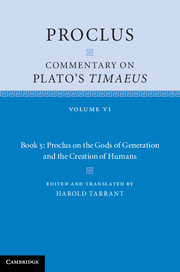
Proclus: Commentary on Plato's Timaeus


Several juicy titles in Neoplatonic Studies are popping up for 2017 already. One is a promising-looking set of studies on Byzantine Perspectives on Neoplatonism, which includes a number of papers on Proclus, Plethon, and the reception of Neoplatonic texts in the Byzantine world. The other is the latest installment in Cambridge UP's series of new translations of Proclus' Commentary on Plato's 'Timaeus'"Volume 6. Book 5: Proclus on the Gods of Generation and the Creation of Humans." These translations - and esp. their introductions and notes - have become indispensible resources for scholars working on Neoplatonism.

26 Δεκεμβρίου 2016

Proclus and his Legacy


Layne, Danielle - Butorac, David D. (eds), Proclus and his Legacy, Walter De Gruyter, Berlin - New York 2017, pp. 449.

 Aims and Scope

This volume investigates Proclus' own thought and his wide-ranging influence within late Neoplatonic, Alexandrine and Byzantinian philosophy and theology. It further explores how Procline metaphysics and doctrines of causality influence and transition into Arabic and Islamic thought, up until Richard Hooker in England, Spinoza in Holland and Pico in Italy. John Dillon provides a helpful overview of Proclus' thought, Harold Tarrant discusses Proclus' influence within Alexandrian philosophy and Tzvi Langermann presents ground breaking work on the Jewish reception of Proclus, focusing on the work of Joseph Solomon Delmedigo (1591-1655), while Stephen Gersh presents a comprehensive synopsis of Proclus' reception throughout Christendom. The volume also presents works from notable scholars like Helen Lang, Sarah Wear and Crystal Addey and has a considerable strength in its presentation of Pseudo-Dionysius, Proclus' transmission and development in Arabic philosophy and the problem of the eternity of the world. It will be important for anyone interested in the development and transition of ideas from the late ancient world onwards.

20 Δεκεμβρίου 2016

New Book: All from One. A Guide to Proclus


All From One: A Guide to Proclus, edited by Marije Martijn and Pieter D’Hoine. Oxford: Oxford University Press, 2017.

The following description is from Oxford's website - see here for more, including TOC.
Proclus (412-485 A.D.) was one of the last official "successors" of Plato at the head of the Academy in Athens at the end of Antiquity, before the school was finally closed down in 529. As a prolific author of systematic works on a wide range of topics and one of the most influential commentators on Plato of all times, the legacy of Proclus in the cultural history of the west can hardly be overestimated.
This book introduces the reader to Proclus' life and works, his place in the Platonic tradition of Antiquity, and the influence his work exerted in later ages. Various chapters are devoted to Proclus' metaphysical system, including his doctrines about the first principle of all reality, the One, and about the Forms and the soul. The broad range of Proclus' thought is further illustrated by highlighting his contribution to philosophy of nature, scientific theory, theory of knowledge, and philosophy of language. Finally, also his most original doctrines on evil and providence, his Neoplatonic virtue ethics, his complex views on theology and religious practice, and his metaphysical aesthetics receive separate treatments.
This book is the first to bring together the leading scholars in the field and to present a state of the art of Proclean studies today. In doing so, it provides the most comprehensive introduction to Proclus' thought currently available.